

Age Spots
Solar Lentigos are small flat dark areas of skin. They appear typically in areas exposed to the sun in patients over the age of 50, however they can appear in younger patients who have had excessive sun exposure.
Age spots affect all skin types; however, they are more common in skin type I, II, III. Unlike Ephelides, Age spots do not fade if sun exposure is avoided.
Common characteristics of Age spots, flat, oval areas of hyperpigmentation, they generally group together making their appearance more pronounced.
Solar Lentigos are composed of two different pigments namely
1. Melanin, the typical pigment in the skin.
2. Lipofusin, an uncommon pigment. A yellow brown pigment composed of oxidized proteins and lipids, which accumulates in the cell’s cytoplasm which increases with ageing.
One of the reasons Age spots seem difficult to treat is due to a majority of treatment plans or products focus on the melanin accumulation only.
When targeting the lipofusin pigment, it is essential to understand that the pigment is a toxin build up. DNA Epinew Skin Tone Corrector incorporates active plant extracts including FERULIC ACID ( an antioxidant that also boosts other antioxidant ingredients) to target the toxins.
Common treatments for Age spots include bleaching ingredients like hydroquione, it is important to remember that these ingredients are not safe on all skin types and a majority of them react adversely when the Age spot is exposed to the sun which is an important to consider. It is safer to use non bleaching ingredients which will control the tyrosinase activity in the skin, whilst distributing the melanin evenly. (Tyrosinase: enzyme that controls melanogenesis)
DermaPlex Anti Dark is ideal for all skin types, it is non bleaching, and does not react if the Age spot is exposed to the sun. The main active ingredient is Hexyresorcinol which is four times more effective than hydroquinone.
Retinol is a tried and tested ingredient when treating skin conditions. Retinol is successful in treating a number of skin conditions including pigmentation, however, depending on the skin type and or current condition of the skin, some skins react aggressively or adversely to retinol.
There are many different forms of retinol:
- RETINYL PALMITATE: Most commonly used, least active form
- RETINALDEHYDE: Slightly more potent than retinyl palmitate
- PURE RETINOL: Strongest non-prescription form of retinol
- TRETINOIN: Potent, only on prescription due to the aggressive side effects
- TAZAROTENE: Potent, only on prescription due to adverse side effects.
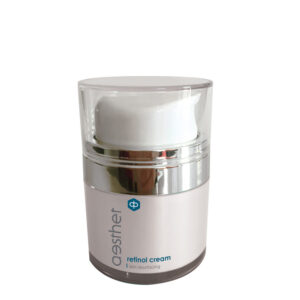
Aesthet Retinol Cream is designed using pure retinol at the highest percent available, the slow release technology gives the best results. Most importantly, it is safe for all skin types as it does not cause a retinizing reaction. (Aggressive dryness, irritation and sensitivity).
Treatment
By combining these 3 steps, Age spots will be easily reduced and effectively treated.
PREVENT: Apply DNA Epinew SPF 30 OR 50)
CONTROL: Apply DermaPlex Anti Dark, DNA Epinew Skin Tone Corrector
RESURFACE: Apply Aesthet Retinol Cream
Prevention
It is important to use and reapply sunscreen regularly. DNA Epinew SPF 30 is an ideal non greasy, moisturising sunscreen. When it comes to reapplying sunscreen, DNA Epinew SPF 50 is suggested as it does not “disturb” your make-up as it is an aerosol spray and convenient to reapply.
Note
Beauty Clinic treatments should always be considered; however, it is advisable to stick to safe treatments like gentle chemical peels, and mesotherapy techniques. Aesthet Expert Chemical Peel is safe for all skin types and focuses on pigmentation.
Dark Circles
Periorbital hyperpigmentation or periorbital melanosis (POM) is a very common condition, whereby hyperpigmentation developers around the periocular region. Many different causes range from genetic or hereditary, post-inflammatory hyperpigmentation, excessive vascularity, atopic or allergic contact dermatitis as well as general ageing.
POM is classified into categories, Huang classification:
Pigmented, typical brown marks.
Vascular, typically pink, blue and purple colours
Structural , facial anatomic contours, and mixed type, typically consists of 2 other types.
It is also well documented, that POM can be due to an abnormality whereby melanocytes are located at the dermal level, this can be due to congenital or acquired causes. This becomes extremely difficult to treat as topically applied creams rarely deliver to the dermis. Due to this, Dr Stem encourages the use of the Mesotherapy, whereby electroporation can safely and painlessly deliver Actives to the dermis without a possible trauma (which can cause a post inflammatory hyperpigmentation).
Most treatment plans will include topical depigmentation agents, like hydroquinone, koljic acid, and retinol. However, many of these ingredients are very harsh especially around the eye area and as such cause many reactions which in turn can worsen the pigmentation.
Treatment
Apply DermaPlex Anti Dark. DermaPlex Anti Dark has been designed as a nonbleaching serum which is safe to use around the eye area.
Note
Other treatments often carried out in practices include chemical peels and laser. Unfortunately, most of these methods are very harsh and not safe around the eye area and not all patients are not ideal candidates for laser. Dr Stem advises safer methods such as enzymatic gentle peel as an alternative using Aesthet Enzymatic Keratopeel.